Christian Freedom Angel Design
A Designer’s First Glance: Graceful, Grounded, and Ready for Real Fabric
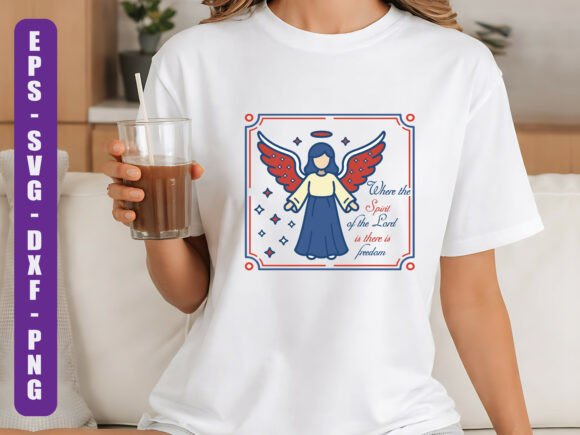
When I opened the Christian Freedom Angel Design file for the first time, I didn’t see just another religious motif—I saw a quiet confidence in its composition. The angel figure is centered but not stiff; wings curve with gentle momentum, and the open hands suggest both surrender and strength. There’s no heavy ornamentation—no dense florals or ornate halos—just clean lines, balanced negative space, and a subtle script phrase (“Freedom in Christ”) that flows like breath rather than decoration. It feels intentional, not decorative. That matters—especially when you’re stitching it onto a soft cotton tote for a church volunteer or embroidering it onto a baby onesie for a baptism gift.
Where This Design Truly Shines (and Why It Fits Your Shop)
I recently used the Christian Freedom Angel Design on a natural linen apron for a local café owner who wanted faith-centered branding without looking preachy. It worked beautifully—not as a statement piece shouting from the front, but as a quiet signature at the chest pocket. That’s the sweet spot: personalized gift, small shop product, custom apparel where meaning meets wearability.
- Tote bag design: Stitches cleanly on medium-weight canvas; wings read clearly even at 3.5" wide.
- Sweatshirt embroidery: Holds up well on fleece-lined fabric with light tear-away stabilizer—no puckering in the wingtips.
- Baby embroidery: Gentle scale and minimal fine detail make it ideal for onesies and burp cloths—no tiny satin-stitch eyes to snag or unravel.
- Embroidered patch: Clean outer edge and moderate stitch density mean it’ll fuse or sew-on cleanly without bulk.
- Holiday embroidery: Works year-round—but especially resonant on Easter tea towels or Advent pillow covers where soft symbolism lands better than bold iconography.
Real Embroidery Considerations—Not Just Theory
This isn’t a “set-and-forget” design. Like any thoughtful machine embroidery design, it asks for attention before it delivers value. Here’s what I checked before stitching my first client piece:
- Stitch density: Moderate fill in the robe and wings—dense enough for coverage on light fabrics, but not so heavy it’ll distort knits.
- Small details: The script phrase uses smooth satin stitch—not ultra-thin running stitch—so it remains legible down to ~2.75" width. Still, I’d avoid going smaller than that on stretchy fabric.
- Hoop size: Fits comfortably in a 4x4 hoop at standard scale. If you’re resizing up for a blanket or banner, watch the inner curves—they’ll need re-digitized tension adjustments if pushed past 6".
- Fabric texture: Performs best on stable weaves (cotton, linen, midweight denim). On textured terry cloth or bouclé, I added a layer of cutaway + topping—it kept the wing outlines crisp.
Where to Proceed With Care
The Christian Freedom Angel Design isn’t built for every surface—and that’s honest design, not a flaw. Use caution on:
- Curved surfaces like caps: The symmetrical layout works, but the center script can compress slightly on low-profile fronts. Test with a mock hoop placement first.
- Dark fabric: The design relies on thread contrast—not shadow or outline—to communicate shape. On navy or charcoal, I switched to ecru or soft gold thread instead of white for warmth and clarity.
- Thin or sheer fabric: Avoid on lightweight rayon or voile without backing—fill areas may show through or shift. A lightweight fusible stabilizer is non-negotiable there.
- Frequent-wash items: While stitch quality is solid, I recommend reinforcing the outer wing edges with a light zigzag or serged seam on finished handmade product like kitchen towels or kids’ blankets.
What It Adds to Your Craft Business—Beyond the Stitch
As an Etsy seller and small-batch decorator, I’ve learned that buyers don’t just buy embroidery—they buy resonance. The Christian Freedom Angel Design elevates a plain sweatshirt into something tender and intentional. It adds giftability to a simple tea towel. It quietly strengthens brand consistency for faith-based boutiques without leaning on cliché. Customers notice that difference—the way the wings aren’t rigid, how the script doesn’t shout, how the whole piece feels *held*, not hurried. That translates directly to repeat orders, photo tags, and word-of-mouth trust.
It also works hard behind the scenes: clean vector-style outlines make it easy to build printable mockups; its balanced proportions scale well across digital embroidery file previews; and because it avoids trend-driven elements (no glitter fonts, no neon gradients), it stays relevant across seasons and customer generations.
Designer Notes You’ll Actually Use
Before stitching your first finished product, do these five things:
- Test on scrap fabric—same type and weight as your final project.
- Check thread color contrast on both light and dark backgrounds using real thread, not screen previews.
- Review stitch density in your embroidery software—if fill areas look overly tight or sparse, adjust underlay or density settings.
- Confirm hoop size and placement—especially if pairing with other designs (e.g., name + angel on a baby blanket).
- Verify licensing before listing as a digital embroidery file or selling stitched items commercially. Some versions allow small-batch use; others require extended licenses for resale.
And one more thing: try it in black-and-white mockups. If the shape holds up without color—clean silhouette, readable gesture, clear hierarchy—that’s when you know you’ve got a keeper. The Christian Freedom Angel Design does.